
About SheCamps™
Rooted in women’s resilience. Built for modern overwhelm.

A Journey to Resilience
SheCamps was born from my own need for a place to breathe.
I needed somewhere I could step out of survival mode, release the pressure of always
being the strong one, and feel safe enough to exhale.
For a long time, I was the woman who kept going because I had to.
I was raising my kids and rebuilding my life after a toxic marriage.
At the same time, I was working in a demanding tech career, holding responsibilities,
and trying to become the version of myself my family needed me to be.
From the outside, I looked capable.
I could solve problems.
I could lead.
I could figure things out.
I could keep moving.
But inside, my body was tired in a way I did not always have words for.
There were moments I would look in the mirror and barely recognize the woman looking back at me. Not because I was gone, but because I had spent so long taking care of everyone else that I no longer knew what I needed, wanted, or dreamed about for myself.
For nearly two decades, I worked in enterprise technology, where corporate pressure, deadlines, constant communication, and high expectations were part of everyday life. That career taught me how to think strategically, solve complex problems, and lead through uncertainty. It also showed me how easy it is to live in a state of constant activation and call it “normal.”
At home, I was also advocating for my son as he navigated life on the autism spectrum, especially within school systems that did not always understand what he needed to feel supported and be successful. I learned what it means to fight for support, ask better questions, pay attention to what a child’s nervous system is communicating, and keep showing up even when the systems around you feel confusing, exhausting, or too slow to respond.
It taught me patience.
It taught me persistence.
It taught me how deeply environments matter.
It taught me that behavior is often communication.
And it taught me that support can change the entire trajectory of someone’s life.
At the same time, I was silently carrying the need to do my own healing.
After years of living in survival mode, including the stress and emotional weight of a toxic marriage, my nervous system had learned how to stay on alert. Even when life started to get better, my body did not always know how to feel safe. That is something many women understand.
You can leave the situation, you can rebuild the life, you can create stability, you can raise your children, you can build a career, you can even look strong doing it. And still, your body may be carrying what you survived.
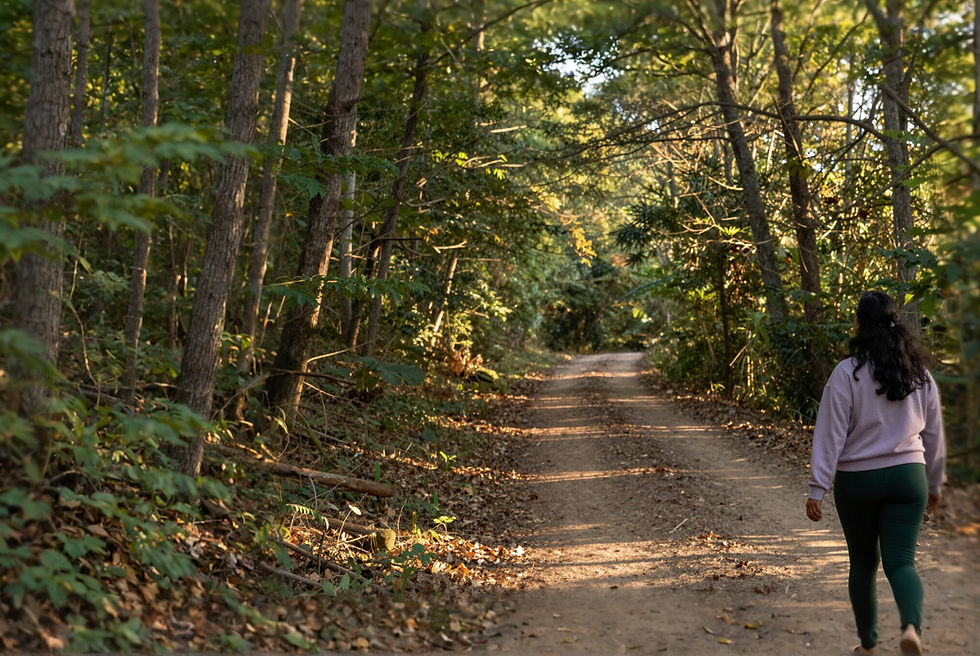
For me, nature became one of the first places where I could stop bracing.
Not because one hike healed everything, not because the outdoors magically fixed my life, but because when I was outside, something in me softened.
The noise got quieter.
My breathing changed.
My mind had room to untangle.
I could walk, cry, pray, think, laugh, and yes, sometimes scream when I needed to. Slowly, I began to remember that I was more than what I had been through.
Nature gave me space without asking me to explain myself. It did not need me to perform, prove, produce, or pretend I was fine. It simply gave my body a place to exhale.
Along the way, I also began meeting other women who were carrying their own stories.
Women who had survived hard marriages.
Women rebuilding after divorce.
Women navigating grief, burnout, motherhood, career pressure, caregiving, identity shifts, and quiet exhaustion.
Women who were strong, capable, and deeply tired.
Women who did not need to be rescued, but desperately needed space to be honest.
What I noticed changed everything.
When women stepped outside together, something changed. The pressure to perform went out the window. The walls came down. Conversations became more real. We could walk side by side instead of sitting face to face trying to explain everything perfectly.
Nature created a kind of permission.
Permission to breathe.
Permission to tell the truth.
Permission to laugh in the middle of healing.
Permission to be strong and tired at the same time.
That shared need for space, fresh air, movement, and honest connection became one of the clearest parts of the SheCamps vision.
I realized women were not only craving calm. They were craving belonging.
A place where they could be seen without having to hold it all together.
A place where healing did not have to feel clinical, lonely, or heavy all the time.
A place where being outside made it easier to open up, regulate, reconnect, and remember that they were not alone.
That is when SheCamps became more than my own reset. It became a vision for creating spaces where women could breathe together, heal in community, and rebuild from a place of steadiness instead of survival.
Not because I had everything figured out, but because I realized how many women are walking around looking strong while quietly feeling overwhelmed, disconnected, and exhausted beneath the surface.
I built SheCamps for her.
For the woman who keeps showing up, but is tired of surviving on autopilot.
For the woman who smiles through every obstacle that comes her way, then lies in bed so burned out she doesn't even know who to ask for help, or how to admit she is unhappy.
For the woman who has carried everyone else for so long that she barely knows what she needs anymore.
For the woman who has learned to function in chaos, but is ready to feel calm in her own body again.
For the woman who does not need another complicated wellness routine or another person telling her to “just relax.”
She needs simple ways to feel seen, heard, and whole again.
She needs space.
She needs support.
She needs belonging.
She needs to remember that strength does not always mean pushing through.
Sometimes strength begins with one honest breath.
That is the heart behind SheCamps: simple nature-based tools, honest connection, and spaces where women can feel steady, supported, and whole again.
Get Outside to Go Inside.
The History Behind the Name SheCamps™

The name SheCamps carries more than an outdoor feeling. It also echoes a nearly forgotten chapter of women’s history.
During the Great Depression, the Civilian Conservation Corps became one of the most well-known New Deal programs, giving millions of unemployed men work, structure, food, shelter, and purpose through conservation projects across the country. But women were largely left out of that model.
First Lady Eleanor Roosevelt saw that gap. She questioned why support programs were being built for men while so many women were also struggling quietly. Women were unemployed. Women were hungry. Women were looking for work, stability, dignity, and a place to belong.
Out of that need came a smaller, women-centered program known informally as the She-She-She camps.
Between the mid-1930s and 1937, these camps offered unemployed women access to shelter, meals, education, training, recreation, and community. By 1936, there were about 90 residential women’s camps, and roughly 8,500 women were served before the program ended.
The She-She-She camps were not perfect. They were short-lived. They were underfunded compared to the men’s programs. They were shaped by the limits, expectations, and social beliefs of their time. But their existence still matters.
Because beneath that history is a truth that still feels deeply relevant today:
Women need spaces where they can be supported, restored, strengthened, and reminded that they matter too.
The women who entered those camps were not just looking for a place to sleep or a way to pass the time. They were looking for steadiness in a world that had become uncertain. They were looking for practical support, community, dignity, and a way to rebuild.
That spirit is part of what inspired the name SheCamps. Not because SheCamps is recreating those historical camps. Not because this is a government program. But because the deeper need has not disappeared.
Women still need places where they can breathe.
Women still need spaces where they do not have to perform strength every second of the day.
Women still need support that honors the full weight of what they carry.
And women still need reminders that rest, reconnection, and restoration are not luxuries. They are part of how we rebuild.
SheCamps carries that spirit forward in a modern way through nature-based tools, nervous system regulation, reflection, community, speaking, journals, and future retreat experiences designed to help women move from chaos to calm in real life.
It is a modern response to a timeless need:
A place for women to breathe, reconnect, and remember their own strength.
The New Deal Summer Camp Program (She She She Camps) History.com
How to Start with SheCamps™
If you have been quietly longing for space to breathe, you are in the right place.
SheCamps is here to help you feel supported without adding more pressure to your life. You do not have to keep holding everything alone, and you do not have to wait until you are burned out, breaking down, or completely out of energy to begin.
There is no perfect place to start. There is only the next honest step.
You might begin with the free Mini Nature Reset Guide. You might choose a journal to help you reflect and reconnect. You might explore The Nature Reset Method more deeply or bring SheCamps to your audience through a workshop, keynote, or group experience.
However you begin, the invitation is the same.
Start small
Step outside
Give yourself a moment to breathe
There is space for you here.